Peerix: WebRTC development made simple
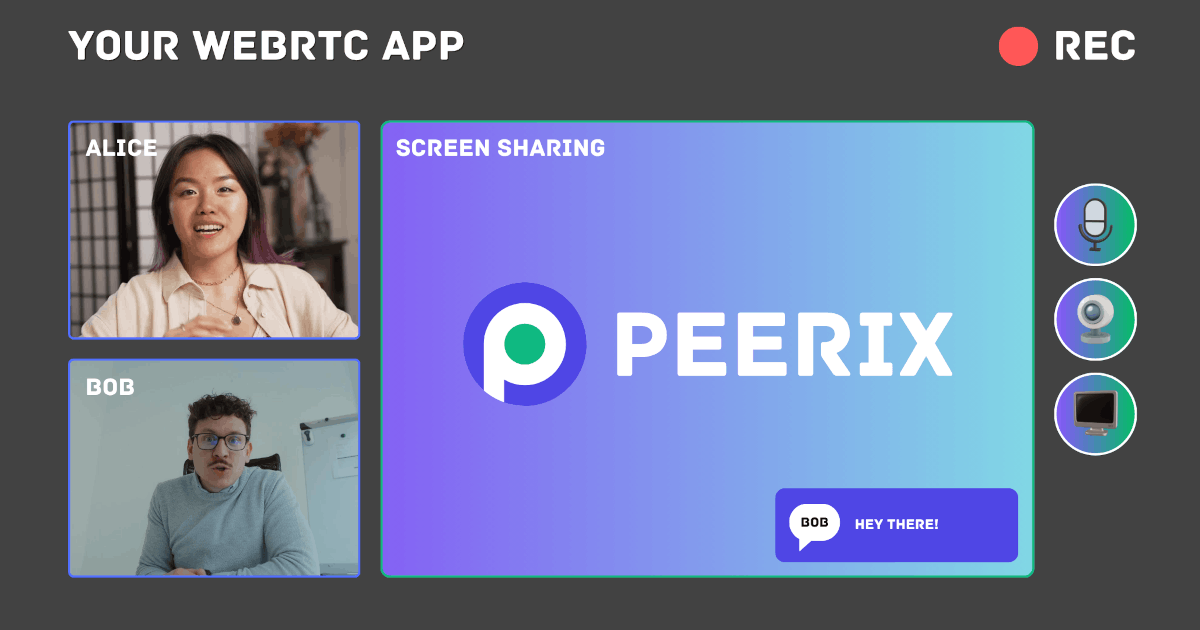
Today, I’m excited to introduce Peerix, a JavaScript/TypeScript library designed to simplify WebRTC development. Peerix abstracts away the complexities of WebRTC, allowing developers to focus on building their applications without worrying about the underlying signaling and peer connection management. With Peerix, you can easily create peer-to-peer applications for video conferencing, file sharing, gaming, and more. Whether you’re a seasoned WebRTC developer or just getting started, Peerix provides a straightforward API to help you get up and running quickly. Check out the comprehensive documentation and start building your next WebRTC application with Peerix today!
Why Peerix?
At its core, Peerix provides a clean, minimal API that handles the heavy lifting of WebRTC. Whether you are building a video conferencing tool, a collaborative whiteboard, or a decentralized file-sharing app, Peerix allows you to get up and running in minutes.
Peerix is not just a high-level wrapper around WebRTC; it also includes features like automatic negotiation, reconnection, peer discovery, state management, and support for multiple signaling servers. This means you can build robust applications that can handle network interruptions and scale to accommodate more users without having to implement these features from scratch. Additionally, Peerix is built with TypeScript, providing type safety and improved developer experience. Whether you’re building a simple chat application or a complex real-time collaboration tool, Peerix has you covered.
Key features include:
- Easy-to-use API for peer connections, media streams, and data channels
- Transport-agnostic design that allows you to choose the best signaling method, including custom implementations
- Supports serverless architecture (no server-side code required)
- Room and state management features to simplify building complex applications
- Multiplexing multiple media streams and data channels over a single connection per peer
- Extensible architecture that allows you to build custom features and integrations
- Cross-browser compatibility with support for all modern browsers
- TypeScript support for a better developer experience and type safety
- Well-documented codebase with comprehensive examples and the API reference
- Automatically tested and optimized for performance and reliability
- Zero dependencies to reduce security risks
- Open-source, actively maintained project
The Core Idea: Efficiency by Design
Peerix operates on a simple principle: one peer-to-peer connection for everything. Rather than creating redundant connections for each stream, Peerix multiplexes media tracks and data channels through one connection per peer. This drastically reduces signaling chatter and saves system resources. Peerix also provides a signaling-agnostic architecture, allowing you to choose your own signaling mechanism, such as WebSockets, NATS, or a custom driver. It implements techniques that minimize signaling overhead. These include using an internal data channel for negotiation and state synchronization, as well as compression and E2E encryption for signaling messages. This means that, even in scenarios with many peers, signaling traffic remains manageable, secure, and efficient. The negotiation implementation automatically handles race conditions and collisions. It also allows you to add custom metadata and labels for each peer connection, stream, and data channel. Finally, Peerix can be easily extended with custom drivers for signaling or add-ons for additional functionality, such as recording and data synchronization.
When (and when not) to use Peerix
Peerix is perfect for:
Developers building real-time apps such as chat, conferencing, file sharing and collaborative tools, as well as gaming apps, who want to avoid reimplementing signalling and connection plumbing, and who need a flexible, extensible foundation for peer-to-peer communication in the browser.
You might not need Peerix if:
You require server-side media processing, such as recording a composite video of 50 people on a server or complex transcoding. Peerix is a client-side P2P powerhouse, not an SFU or MCU.
Open Source & Sustainability
Peerix is dual-licensed. We believe in the power of the community, which is why the library is available under the GPLv3 for open-source projects.
For developers building proprietary applications who need to avoid copyleft obligations, we offer a commercial license. This model allows us to keep the project actively maintained and sustainable for years to come.
If you’re interested in contributing, or if you have any questions, please take a look at our GitHub repository and join the discussion. We look forward to seeing what you build with Peerix!
See it in Action
Try out the Peerix library in the sandbox environment below. You can open multiple tabs with the sandbox in the same browser to simulate multiple peers and see how they interact with each other using Peerix.
Comments