LLM performance on AMD GPU with ROCm 7.x vs 6.x
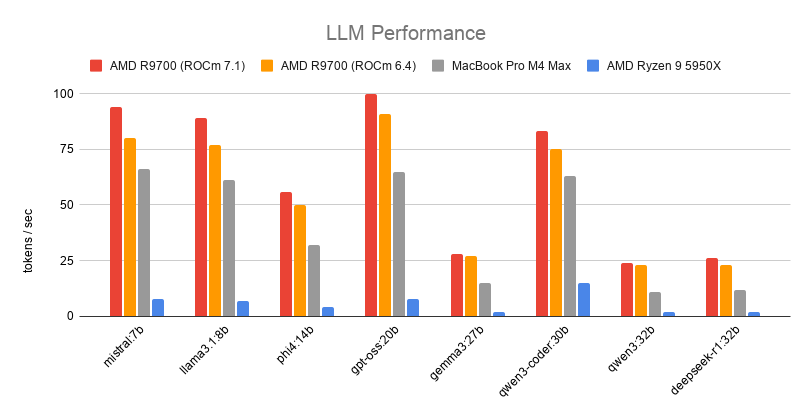
In this post, I compare the performance of large language models (LLMs) on the AMD Radeon AI PRO R9700 using Ollama with different ROCm versions. The R9700 is a powerful GPU designed for professional workloads, including machine learning and AI applications. In my previous post, LLM performance on AMD Radeon AI PRO R9700, I tested LLM performance with ROCm 6.4. Now, let’s see how ROCm 7.1 compares.
Hardware
The PC used for testing is equipped with the following specifications:
- Motherboard: B550 AORUS ELITE AX V2
- GPU: AMD Radeon AI PRO R9700 (32 GB VRAM, RDNA 4)
- CPU: AMD Ryzen 9 5950X (16 cores / 32 threads)
- RAM: 64 GB DDR4-2666
- Storage: NVMe Samsung SSD 970 EVO Plus 1TB (x2)
Test environment
For LLM performance testing, I used the following environment:
docker run -d --name ollama --device /dev/kfd --device /dev/dri \
  -e "HSA_OVERRIDE_GFX_VERSION=12.0.0" \
  -v ollama:/root/.ollama -p 11434:11434 ollama/ollama:rocm
Instead of the rocm tag, I used 0.12.11-rocm for ROCm 6.4 and 0.30.0-rocm for ROCm 7.1.
Pull and run each LLM model (repeat for every model):
docker exec -it ollama ollama run mistral:7b --verbose

> Tell me a story about a brave knight who saves a village from a dragon.

...

total duration:       9.705420035s
load duration:        12.444423ms
prompt eval count:    21 token(s)
prompt eval duration: 31.977818ms
prompt eval rate:     656.71 tokens/s
eval count:           904 token(s)
eval duration:        9.5508627s
eval rate:            94.65 tokens/s
Performance comparison
ROCm 6.4 (Ollama v0.12.11)
| Model | VRAM | Prompt | Response |
|---|---|---|---|
| mistral:7b | 6 GB | 414 t/s | 80 t/s |
| llama3.1:8b | 7 GB | 386 t/s | 77 t/s |
| phi4:14b | 12 GB | 213 t/s | 50 t/s |
| gpt-oss:20b | 13 GB | 704 t/s | 91 t/s |
| gemma3:27b | 19 GB | 207 t/s | 27 t/s |
| qwen3-coder:30b | 18 GB | 250 t/s | 75 t/s |
| qwen3:32b | 21 GB | 179 t/s | 23 t/s |
| deepseek-r1:32b | 22 GB | 99 t/s | 23 t/s |
ROCm 7.1 (Ollama v0.30.0)
| Model | VRAM | Prompt | Boost | Response | Boost |
|---|---|---|---|---|---|
| mistral:7b | 6 GB | 656 t/s | +58% | 94 t/s | +18% |
| llama3.1:8b | 7 GB | 786 t/s | +104% | 89 t/s | +16% |
| phi4:14b | 12 GB | 592 t/s | +178% | 56 t/s | +12% |
| gpt-oss:20b | 13 GB | 972 t/s | +38% | 100 t/s | +10% |
| gemma3:27b | 19 GB | 346 t/s | +67% | 28 t/s | +4% |
| qwen3-coder:30b | 18 GB | 463 t/s | +85% | 83 t/s | +11% |
| qwen3:32b | 21 GB | 287 t/s | +60% | 24 t/s | +4% |
| deepseek-r1:32b | 22 GB | 201 t/s | +103% | 26 t/s | +13% |
Conclusion
Across the tested models, ROCm 7.1 improved response speed by 11% and prompt processing speed by 87% compared to ROCm 6.4. This shows that AMD’s ROCm 7.x optimizations with Ollama have a significant impact on LLM performance, making this stack a strong choice for AI workloads on AMD GPUs.
Comments